This being Independence Day weekend, which is one of the major vacation/trip weekends, it seems appropriate to bring up a former American automaker with deep Wisconsin roots.
Hot Rod magazine committed one of the great April Fool’s jokes in the history of magazine publishing when it breathlessly reported in its April 2008 issue that a group of private investors were working to bring back the late American Motors Corp. (The disclaimer at the beginning of the Web page didn’t appear until the last paragraph of the printed version.)
As with any successful practical joke, this one worked because of the appearance of plausibility. Given that the 2008 Ford Mustang looked like the 1967–68 Mustang, and given that Chrysler resurrected the Dodge Challenger and General Motors Corp. brought back the Chevrolet Camaro, is it possible that someone might want to resurrect the AMC Pacer …

… or, even better, the Javelin?

First, some history: AMC, the child of the marriage of the Nash and Hudson brands, was the smallest member of the Big Four automakers, until Chrysler purchased it in 1987 to get the Jeep brand into the Chrysler fold. AMC’s corporate headquarters were in the Detroit area, but its cars were built in Kenosha and Milwaukee (a Nash plant built in 1901).

AMC first had a reputation for building compact cars, such as the Rambler, in an era in which compact cars were only sporadically popular. One of AMC’s presidents was Gerald Romney, a later governor of Michigan and Republican presidential candidate, and father of presidential candidate Mitt Romney.
Having much less capital than its bigger three competitors, AMC nonetheless built some cars that were ahead of their time, thanks in large part to the work of chief stylist Richard Teague. The company first took its sporty Javelin, chopped off the rear end …
… and created the two-seat AMX, a cult car among collectors today.
A couple years later, AMC took its compact Hornet, similarly sliced off the rear end …

… and created the subcompact Gremlin (an unfortunate name for anything motorized), a car you could buy with a Levi’s interior.

Whoever thought of adding four-wheel-drive to the compact Concord (born as the aforementioned Hornet 10 years earlier) created the Eagle, America’s first crossover sport utility (car with four-wheel-drive-truck-like capabilities), predating the Subaru Outback and other all-wheel-drive-equipped cars by 15 years.

Then, in 1983, came the downsized Jeep Cherokee, the first sport utility not based on a full-size pickup truck. An AMC subsidiary, AM General, began work in the late 1970s on something the U.S. Army called the “High Mobility Multipurpose Wheeled Vehicle” — which, two owners and a marketing agreement with General Motors later, the world came to know as the Hummer.
Other AMC cars were not great cars, but at least they stood out on the street, such as the Marlin …

… which arguably looked better as the Tarpon show car, based on a smaller model than the Marlin ended up being …

… the aforementioned Gremlin and …
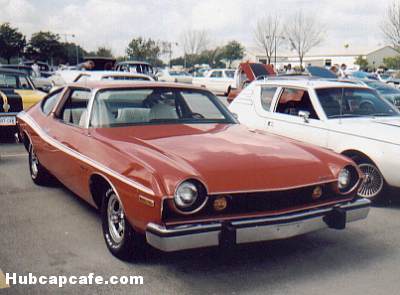
… the final two-door and four-door versions of the Matador. Like the Pacer, the Matador coupe was in a class of one, while the last four-door Matador was referred to as “coffin-nose.” AMC seemed to have two kinds of styling: staid and really out there.
Of course, AMC had long history with, shall we say, interesting-looking large cars. The Hudson Hornet, which detractors said looked like an upside-down bathtub with wheels …

… was, in the not-intended-as-a-compliment words of car magazine editor David E. Davis Jr., resurrected as the early 1990s Chevrolet Caprice:

On the other hand, the aforementioned Hornet (which you’ve seen if you’ve seen the movie “Cars”) was also an example of AMC’s ability to do more with less. Despite having just a six-cylinder engine, the Hornet was one of the dominant cars of the early years of NASCAR, thanks to its lower center of gravity from said upside-down-bathtub design, and the heavily-breathed-upon six.
The car I wish AMC had brought out would have been the replacement for the AMX when it was merged into the Javelin line (which meant the AMX wouldn’t have just two seats anymore) was …

… the AMX/3, a mid-engine/rear-drive halo car designed in Italy but with an AMC 390 V-8. I have a 1970 issue of Popular Mechanics that includes the AMX/3 as one of AMC’s 1971 offerings. The AMX/3 was unveiled one day after Lincoln–Mercury unveiled its De Tomaso Pantera, and that supposedly scared off AMC. (The Pantera didn’t last long either, which is too bad; while I should favor Ford since, unlike GM and Chrysler, it received no government aid, Ford also doesn’t have anything like the Corvette either.)
AMC and its predecessors also had a history of some unusual design and engineering decisions. Early 1960s Ramblers had push-button shifting for its automatic transmissions. On the other hand, AMC for some reason thought it would be innovative to remove the zeros from speedometers, making them read from 0 to 12 instead of 0 to 120 mph. To get the most out of one steering wheel design, the steering wheel was mounted upside down on the Gremlin and Hornet models. The last Javelin’s air conditioning controls required the owner to read the owner’s manual more than once — one slide controlled the fan, one controlled the heat, one controlled the outlets from which the air blew, and the last was for the air-conditioned air, including a “Desert Only” setting, prolonged use of which, owners were warned, could lead to loss of cool air due to coolant freezing.
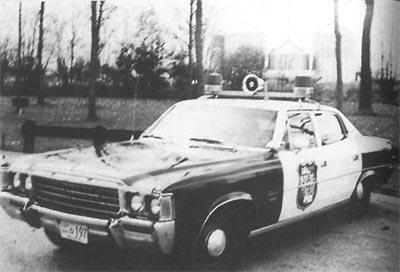
One unusual AMC niche was in police cars. Anyone who watched “Adam-12,” “The Rockford Files” or “The Dukes of Hazzard” (I plead guilty to all three — any series with cool cars got my attention) might remember that those series all featured Matador police cars. Many law enforcement agencies used Matadors because they probably were less expensive than their Big Three competition. (I once saw a sign in a National Guard armory that reminded everyone that all of their equipment was produced by the lowest bidder.) I don’t remember seeing Matador police cars in Wisconsin, but for several years in the early ’70s the Wisconsin State Patrol used Ambassador squad cars. So did a few sheriff’s departments, including Dane County, at least until a well-publicized spat between either AMC or the Madison AMC dealer and the sheriff over sheriff’s deputies’ habit of crashing said Ambassadors. (The dealership, from which we purchased a 1973 Javelin (read further), is still in business today, though it sells used cars now.) The Alabama Highway Patrol and the Muskego police used Javelins for a while.
The Nash+Hudson=AMC merger came right after Studebaker and Packard merged, which lasted only until 1966, when Studebaker–Packard closed its Hamilton, Ont., plant, two years after it closed its South Bend, Ind., plant. Studebaker and AMC apparently were talking about merging before AMC president George Mason, well, died in 1954. That put Romney in charge of AMC, and Romney was opposed to using Studebaker parts, and that ended the merger idea. Which seems too bad, given that StudePackAMC might have had enough brands to compete with every Big Three brand, from Nash at the Chevrolet/Ford/Plymouth level to Packard at the Cadillac/Lincoln/Chrysler level. (As owners of Plymouths, Pontiacs, Oldsmobiles, Mercurys — Mercuries? — and Saturns know, that wouldn’t have been sustainable long-term, but one crisis at a time.)
There are conflicting schools of thought as to why AMC finally folded with its purchase by Chrysler. Patrick Foster, author of American Motors: The Last Independent, argues that AMC did fairly well in the 1960s, offering economical (for the day), sturdily built, stolid cars (similar to Mercedes-Benz in the day), until AMC management decided it needed to offer what the other members of the Big Four were offering — sporty cars (although the Javelin was quite successful in the Trans Am series) and big cars, products where AMC lacked the ability to compete with GM, Ford and Chrysler.

I maintain that the reason AMC doesn’t exist today as an independent manufacturer has to do with a decision the company made during the early 1970s to discontinue building its Javelin “pony car.” Chevrolet built many more Camaros and Ford built many more Mustangs than AMC built Javelins, but the Javelin and its AMX two-seat cousin developed a reputation as race cars whose performance exceeded their reputation. The last year of the Javelin was 1974, just before the pony car market exploded and General Motors sold as many Camaros and Pontiac Firebirds as they could build.

This (minus the vinyl roof, and the horses, and my parents didn’t look like that) was our 1973 Javelin, our first new second car. It was also the first car I drove on public roads. It had a 304 V-8, automatic transmission with floor shifter (first I’d ever seen in a car), bucket seats and console, power steering (but not brakes), and AM radio. It was a cool-looking car from the front seats forward, with a back seat suitable only for dolls, and a trunk large enough for the spare tire and a golf bag, and that’s it.
The Javelin was an example of AMC’s less-than-sterling quality reputation, although to be fair many ’70s cars were similarly lacking. The gold tape stripe on the side started cracking seconds after the 12-month 12,000-mile warranty expired. The car started rusting shortly thereafter, although rust on a brown car is easier to not notice. Even at age 8 I could tell that things didn’t seem to fit together that well. Most of the interior screws were dislodged after a Boy Scout camping trip in which the camping spot was at the end of a rough gravel road.
The Javelin was killed after the 1974 model year. Instead of the Javelin (and the luxury Ambassador, killed at the same time), AMC built …
… the Pacer, a car that was small in length, but wider and thus roomier (or so AMC wanted the consumer to believe) than the average small car. It was, however, heavy for its length due to big windows and slow yet fuel-inefficient even for that time, and, as the New York Times put it, it “looked like nothing else on the road,” a plus perhaps only in the minds of Wayne and Garth.
With AMC lacking money, 25 percent of AMC was sold to Renault (leading to the AMC Alliance and Fuego) before Chrysler purchased all of AMC in 1987. Chrysler closed the Milwaukee manufacturing plant in 1988, and closed the Kenosha plant (which was being used to build Chrysler engines) in 2008, just before GM closed its Janesville plant. (My family must be a curse upon carmakers, since our family’s garage simultaneously housed a Kenosha-built Javelin and a Janesville-built Chevrolet Caprice. My parents also owned two of the last Oldsmobiles, and my father owned a Studebaker Hawk many years ago. Someone should warn Cadillac, Subaru and Honda of this.)
Given how things for the remaining Big Three automakers today — as in GM owned by the taxpayers and Chrysler owned by Fiat — it’s hard to imagine how AMC could have made it to today had the sale to Chrysler not occurred. It is fun to contemplate, though, what could have happened had the“group of like-minded venture capitalists pooling billions of dollars to create the ultimate U.S. car company, and without the hindrance that comes with being a public company” been more than the figment of a creative writer’s imagination. That, however, would give the lie to the old saw that the difference between fiction and reality is that fiction has to make sense.

 Steve Prestegard.com: The Presteblog


Leave a comment